First, the law
In Singapore the green tree frog is approved wildlife for keeping at home. No licence is needed. The conditions are strict: not for sale, public display, transfer or breeding, and kept only in a residence. Individuals cannot import one; buy from an AVS-licensed pet shop.
So we build the enclosure with you, and the frog comes from a licensed shop and lives at your home. That is the law. It is also good practice.
The enclosure, on one card
| What we build to | Why | |
|---|---|---|
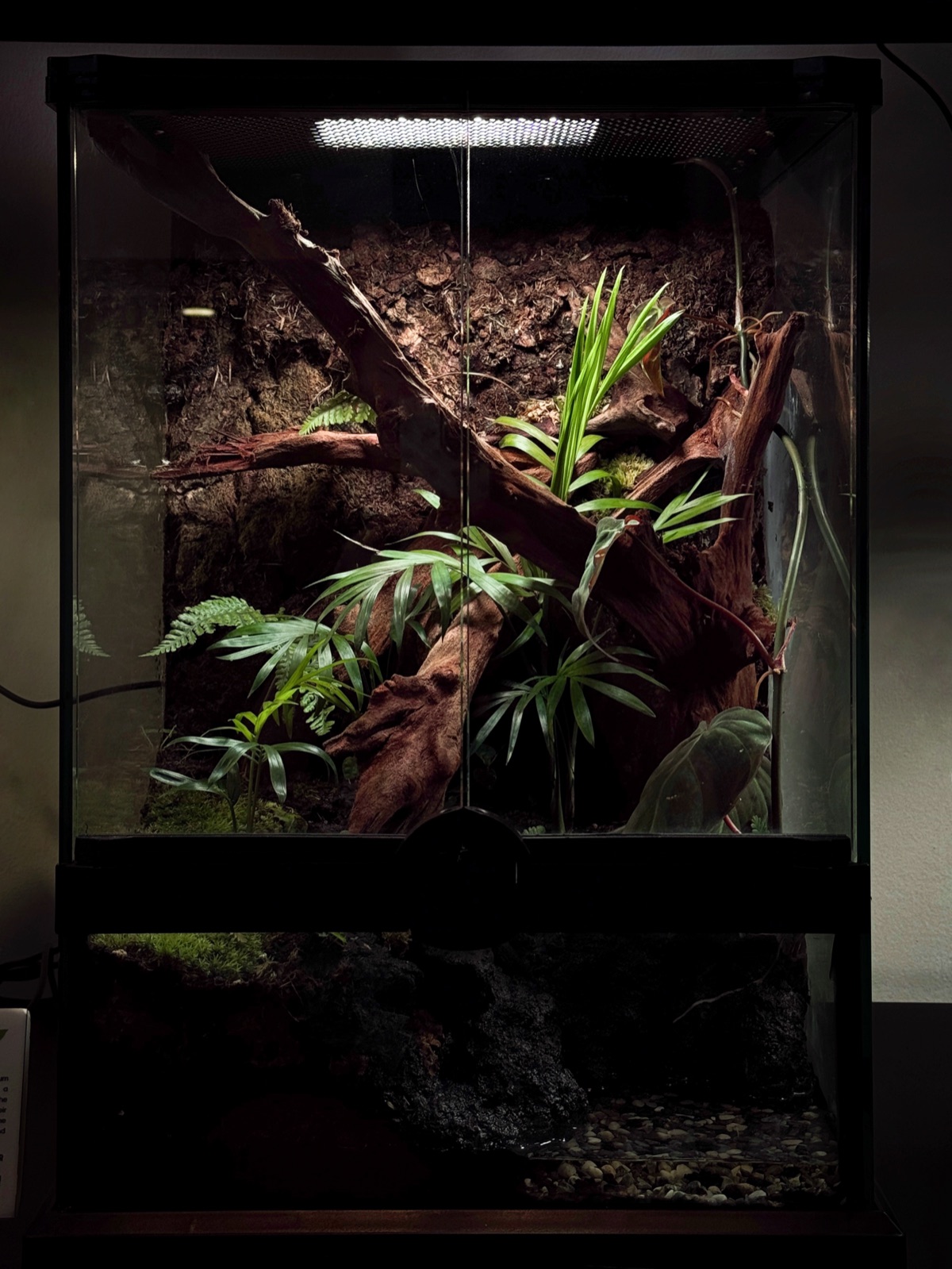
| Size | 45 × 45 × 60 cm for one adult. 60 × 45 × 90 for two or three. Height at least equal to width | An arboreal (tree-living) frog climbs; it needs height more than floor |
| Ventilation | At least half the top in mesh, plus a low vent at the front | Cross-flow. Stagnant wet air is the number one killer here |
| Substrate | Coco fibre over a clay-ball drainage layer, capped with large leaf litter. Nothing smaller than 5 mm | This frog shovels food in with its hands and swallows substrate with it. Gravel and small bark cause fatal blockages |
| Water dish | Large, shallow, easy to climb out of, deep enough for the hind legs to touch bottom. Dechlorinated, changed daily | It soaks to drink through its skin. Chlorine and chloramine go through the skin too |
| Furnishing | Cork rounds and branches for perches, sturdy broad-leaf plants, a shaded retreat | Perches at different heights let it choose its own temperature |
Temperature and humidity, the Singapore version
Day: 24 to 29 °C across the tank, with one basking perch at 32 to 35 °C under a lamp. In a warm room the lamp is optional; in an air-conditioned room at 22 to 24 °C it is not.
Night: it must drop to 18 to 22 °C. Air-conditioning gives you this for free. A non-conditioned room needs a fan-assisted mesh top, or the frog never gets its night.
Humidity: mist at lights-off so it spikes to 70 or 80 percent, then let it fall to 50 or 60 by midday. Never hold it above 80. That daily dry-down (the air drying out between mists) is what keeps skin and lungs healthy.
Light
Twelve hours on, twelve off, on a timer, all year. A low-output UVB tube (Ferguson Zone 2) 25 to 30 cm above the top perch, replaced every twelve months, with shade available below. A plant LED alongside it, not an incandescent bulb, which overheats a humid tank.
Feeding
Adults eat two or three times a week: four to six insects, none wider than the gap between the frog's eyes, dusted with calcium, offered by tongs at dusk. Juveniles eat daily. This species will eat whatever it is shown, and almost every chronic illness in captivity traces to overfeeding. Feed the frog, not the reflex.
What goes wrong here
Wet, still air: skin and respiratory infections. No night drop: a frog that stops eating. Gravel or fine bark: impaction. Too many crickets: obesity. A new frog straight into the display: chytrid, a skin fungus that kills. Quarantine every new frog for 30 to 90 days first, and handle only with wet nitrile gloves, never with lotion or sanitiser on your hands.
Questions, answered
Do I need a heater in Singapore?+
Usually not for the room, but yes for one basking spot in an air-conditioned room. A small lamp over the top perch, on the same timer as the lights.
Can I keep the enclosure in an air-conditioned room?+
Yes, and it solves the night drop for you. Add the basking lamp for the day and watch humidity, which falls fast in conditioned air.
Can Chai Chee Safari sell me the frog?+
No. Under AVS rules the species is for residential keeping only, and sale needs a licensed pet shop. We build the enclosure with you; the frog comes from a licensed shop.
How long do they live?+
Sixteen years on average in good care, with records past twenty. Plan the enclosure, and the household, for that.
Build it with us.
The Canopy tree frog workshop builds this exact enclosure with you, from $480. Prefer it built and delivered? The Canopy Signature starts at $980. Either way, send us a photo of the spot first and we will tell you what fits.
Reviewed Sep 2026 · Tng Di Kai, founder